
Ultrafast Availability vs Uptake
A look into the availability of ultrafast broadband around the UK and why so few people are looking to take it up.
This report was originally published in 2022. For the latest figures, read our 2025 update.
Speedy Supply, Lagging Demand: Ultrafast Broadband Availability and Uptake in the UK
Ofcom data, analysed by the team at BroadbandUK, has shown that despite the UK Government's push to deliver Project Gigabit, uptake simply doesn't match the increased availability of full-fibre, gigabit-capable broadband.
The latest Connected Nations 2022 report by Ofcom, which uses data collected in May 2022, shows that there has been a shift away from Standard connections (<30 Mbit/s) to Superfast connections (30-300 Mbit/s), but uptake of Ultrafast connections (>300 Mbit/s) is lagging.
Before we get into the data, let's remind ourselves of the Government's pledge to provide faster internet to rural and hard-to-reach areas in the UK.
What is Project gigabit?
The UK Government's Project Gigabit is a multi-billion-pound plan to bring gigabit-capable broadband to hard-to-reach areas across the country. The goal of the project is to connect 85% of the UK to gigabit-capable broadband by the end of 2025.
In a winter 2023 update, the UK government provided new information on the progress of the Project Gigabit rollout. The government announced that it has reached agreements with more than 200 suppliers to deliver gigabit-capable broadband to hard-to-reach areas across the UK. These agreements will help to ensure that the project stays on track to meet its goal of reaching 85% of the UK by the end of 2025.
The government also announced that it has opened up applications for funding from the Gigabit Broadband Voucher Scheme, which provides funding to small and medium-sized businesses and residential properties in rural areas to help them access gigabit-capable broadband. The scheme has already provided vouchers to over 37,000 properties across the UK.
Current full-fibre availability in the UK
In a recent statement by Ofcom's group director of network and communications, Lindsay Fussell, it was announced that full-fibre broadband is set to reach 50% of UK homes and businesses by March 2023, representing a significant milestone in the government's efforts to improve the country's broadband infrastructure.
What is the real picture? Availability vs uptake
| Region | Standard | Superfast | Ultrafast | +/- Standard | +/- Superfast | +/- Ultrafast |
|---|---|---|---|---|---|---|
| East Midlands | 14.09% | 77.28% | 8.63% | -11.84% | 7.15% | 4.69% |
| East of England | 15.30% | 76.13% | 8.57% | -11.93% | 7.13% | 4.80% |
| Greater London | 11.79% | 75.65% | 12.56% | -12.95% | 5.84% | 7.12% |
| North East | 15.21% | 73.37% | 11.42% | -12.76% | 5.96% | 6.80% |
| North West | 14.14% | 76.89% | 8.98% | -12.43% | 7.53% | 4.89% |
| Northern Ireland | 14.44% | 74.53% | 11.03% | -16.52% | 8.88% | 7.64% |
| Scotland | 17.07% | 74.25% | 8.67% | -12.41% | 7.82% | 4.59% |
| South East | 14.43% | 75.95% | 9.62% | -11.89% | 6.48% | 5.41% |
| South West | 18.86% | 72.64% | 8.50% | -13.58% | 8.70% | 4.89% |
| Wales | 16.18% | 78.51% | 5.31% | -13.05% | 9.93% | 3.12% |
| West Midlands | 13.34% | 76.50% | 10.16% | -12.97% | 7.46% | 5.52% |
| UK Total | 14.71% | 75.65% | 9.64% | -13.61% | 7.87% | 5.74% |
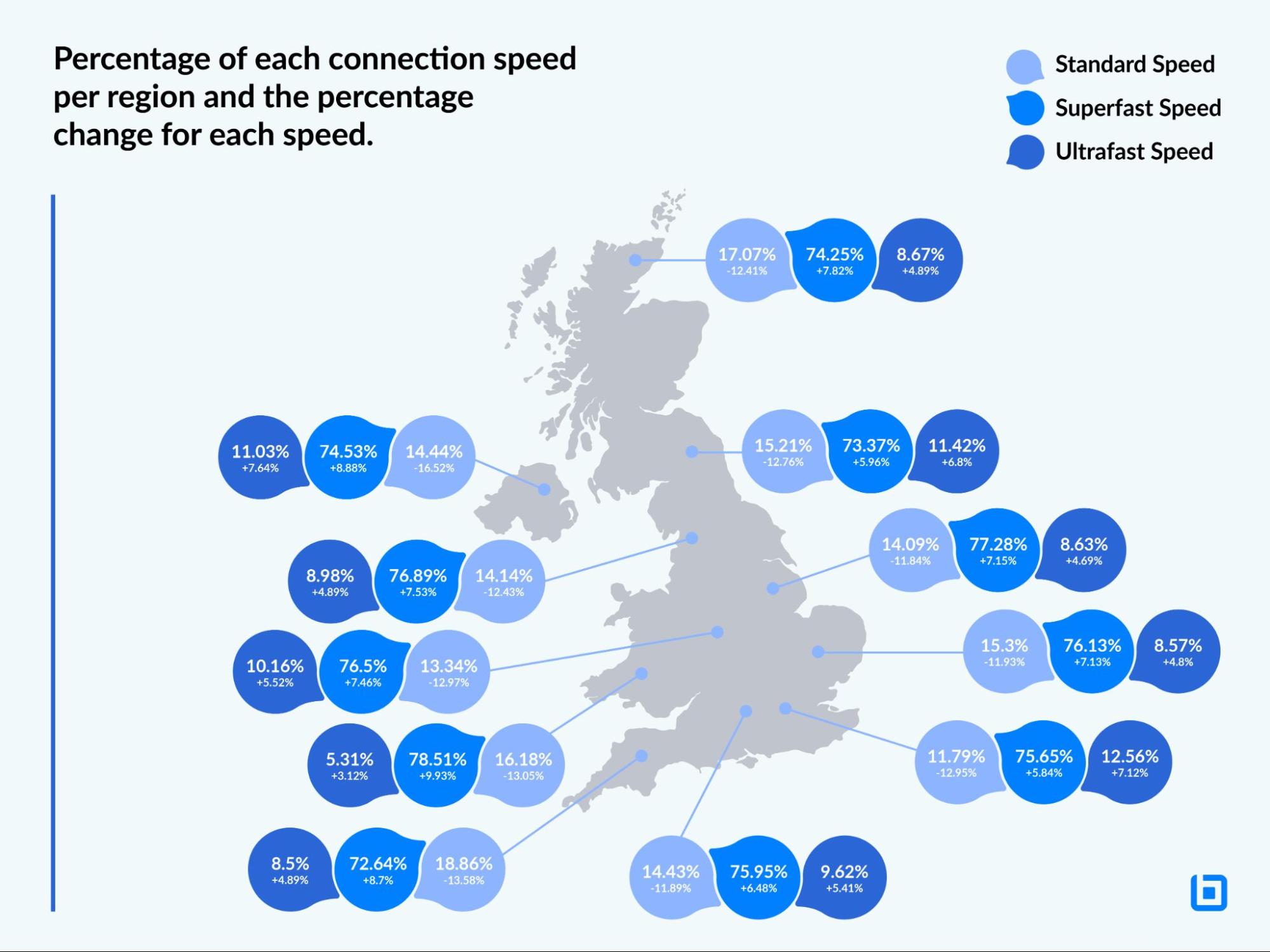
The graphic and supporting table presents the distribution of internet connection speeds across UK regions, along with the percentage change for each speed since Ofcom's Spring 2022 Connected Nations report, which is a snapshot from Jan 2022 . The percentages of connection speeds are as follows:
- Standard connections range from 11.79% in Greater London to 18.86% in the South West.
- Superfast connections range from 72.64% in the South West to 78.51% in Wales.
- Ultrafast connections range from 5.31% in Wales to 12.56% in Greater London.
The percentage changes in connection speeds show that Standard connections have generally decreased across all regions, with the largest decrease in Northern Ireland (-16.52%) and the smallest in the East of England (-11.93%).
Superfast connections have increased in all regions, with the largest increase in Wales (9.93%) and the smallest in Greater London (5.84%).
Ultrafast connections have also increased in all regions, with the highest increase in Greater London (7.12%) and the lowest in Wales (3.12%). Overall, the UK has seen a decrease in Standard connections (-13.61%) and an increase in both Superfast (7.87%) and Ultrafast connections (5.74%). LP
At town/city level:
- The highest share of Standard connection speed is found in Kirkwall (38.37%), while the lowest is in Hull (8.05%) and Harrow (9.84%). The largest declines in Standard connection speeds were seen in Hull (-16.57%) and Belfast (-16.52%).
- Superfast connection speeds are highest in Cardiff (81.29%) and lowest in Hull (55.90%) and Kirkwall (61.45%). The largest increase in Superfast connection speeds was seen in Llandrindod (12.57%).
- Hull comes out on top, in terms of Ultrafast connections (36.05%) followed by Sutton (14.01%) whilst the lowest was seen in Comhairle nan Eilean Siar (0.35%). The largest increase in Ultrafast connection speeds was observed in Hull (22.51%), followed by Salisbury (8.09%).
Note: KCOM's rolled out its full fibre network in Hull in 2019, putting Hull years ahead in terms of availability. This will account for greater uptake in the city compared to areas where full fibre has only been made available more recently.
Saveen Rajan, CEO of BroadbandUK, comments:
“Despite the continuous expansion of Ultrafast broadband infrastructure across the UK, there is a significant gap between its availability and the actual uptake by consumers. This underscores the urgent need for not only increasing public awareness about the benefits of Ultrafast connections but also effectively addressing affordability concerns.”
A full breakdown by town/city is shown below:
| Town/City | Standard | Superfast | Ultrafast | +/- Standard | +/- Superfast | +/- Ultrafast |
|---|---|---|---|---|---|---|
| Aberdeen | 22.51% | 75.80% | 1.70% | -10.83% | 10.47% | 0.37% |
| Bath | 18.95% | 75.22% | 5.82% | -12.87% | 9.29% | 3.57% |
| Belfast | 14.44% | 74.53% | 11.03% | -16.52% | 8.88% | 7.64% |
| Birmingham | 12.25% | 75.19% | 12.56% | -14.15% | 7.36% | 6.79% |
| Blackburn | 12.87% | 80.12% | 7.02% | -11.54% | 7.61% | 3.94% |
| Blackpool | 16.47% | 77.16% | 6.37% | -11.90% | 8.22% | 3.68% |
| Bolton | 12.26% | 79.02% | 8.72% | -12.12% | 7.31% | 4.82% |
| Bournemouth | 17.86% | 74.62% | 7.52% | -11.30% | 7.56% | 3.74% |
| Bradford | 16.85% | 74.98% | 8.17% | -12.42% | 8.00% | 4.42% |
| Brighton | 14.54% | 77.11% | 8.35% | -12.01% | 7.12% | 4.89% |
| Bristol | 13.66% | 73.23% | 13.10% | -14.20% | 7.08% | 7.11% |
| Bromley | 13.98% | 72.67% | 13.35% | -12.82% | 6.16% | 6.66% |
| Cambridge | 12.99% | 76.87% | 10.13% | -11.67% | 6.17% | 5.49% |
| Canterbury | 19.72% | 74.29% | 5.98% | -11.22% | 7.32% | 3.90% |
| Cardiff | 11.81% | 81.29% | 6.89% | -11.43% | 7.59% | 3.83% |
| Carlisle | 18.20% | 79.85% | 1.95% | -10.20% | 9.03% | 1.17% |
| Chelmsford | 15.27% | 74.39% | 10.33% | -13.00% | 6.98% | 6.00% |
| Chester | 15.90% | 75.72% | 8.38% | -12.33% | 7.59% | 4.73% |
| Cleveland | 14.67% | 71.49% | 13.84% | -13.42% | 5.92% | 7.50% |
| Colchester | 18.17% | 73.68% | 8.15% | -13.03% | 8.27% | 4.77% |
| Comhairle nan Eilean Siar | 28.99% | 70.66% | 0.35% | -4.70% | 4.50% | 0.20% |
| Coventry | 11.83% | 78.21% | 9.96% | -12.71% | 7.54% | 5.18% |
| Crewe | 16.24% | 80.17% | 3.60% | -10.79% | 8.84% | 1.96% |
| Croydon | 14.95% | 72.49% | 12.56% | -13.05% | 6.39% | 6.66% |
| Darlington | 16.90% | 76.71% | 6.40% | -11.65% | 7.54% | 4.13% |
| Dartford | 14.03% | 73.83% | 12.14% | -12.49% | 5.74% | 6.75% |
| Derby | 14.69% | 77.42% | 7.89% | -11.83% | 7.67% | 4.16% |
| Doncaster | 15.99% | 75.61% | 8.40% | -11.92% | 7.28% | 4.64% |
| Dorchester | 22.03% | 76.70% | 1.27% | -10.03% | 9.15% | 0.88% |
| Dudley | 13.67% | 76.36% | 9.96% | -12.30% | 7.13% | 5.17% |
| Dumfries | 25.71% | 73.31% | 0.97% | -9.79% | 9.20% | 0.58% |
| Dundee | 15.97% | 75.51% | 8.52% | -12.16% | 7.67% | 4.49% |
| Durham | 18.18% | 76.91% | 4.92% | -9.26% | 5.28% | 3.99% |
| Edinburgh | 13.47% | 74.90% | 11.63% | -13.59% | 7.52% | 6.07% |
| Enfield | 11.44% | 77.21% | 11.35% | -11.99% | 6.62% | 5.37% |
| Exeter | 22.38% | 71.81% | 5.81% | -13.90% | 10.19% | 3.72% |
| Falkirk | 17.05% | 74.11% | 8.84% | -11.80% | 7.76% | 4.03% |
| Galashiels | 23.44% | 75.41% | 1.16% | -11.10% | 10.47% | 0.64% |
| Glasgow | 12.11% | 75.60% | 12.29% | -13.11% | 6.86% | 6.25% |
| Gloucester | 18.53% | 70.29% | 11.18% | -14.10% | 8.03% | 6.07% |
| Guilford | 12.64% | 77.03% | 10.33% | -11.63% | 5.98% | 5.65% |
| Halifax | 16.68% | 77.56% | 5.76% | -12.33% | 9.13% | 3.20% |
| Harrogate | 17.51% | 73.25% | 9.24% | -13.07% | 7.87% | 5.20% |
| Harrow | 9.84% | 77.24% | 12.92% | -11.93% | 4.33% | 7.59% |
| Hemel | 13.29% | 76.81% | 9.90% | -11.68% | 6.06% | 5.62% |
| Hereford | 20.77% | 75.29% | 3.94% | -13.35% | 11.32% | 2.03% |
| Huddersfield | 16.46% | 74.95% | 8.59% | -12.39% | 7.93% | 4.46% |
| Ilford | 11.22% | 75.29% | 13.48% | -12.88% | 5.94% | 6.93% |
| Inverness | 29.76% | 68.41% | 1.83% | -9.31% | 8.10% | 1.21% |
| Ipswich | 17.73% | 77.39% | 4.88% | -10.17% | 7.37% | 2.80% |
| Kilmarnock | 19.85% | 74.33% | 5.82% | -11.00% | 7.81% | 3.19% |
| Kingston | 11.13% | 75.61% | 13.25% | -12.25% | 5.39% | 6.85% |
| Kingston upon Hull | 8.05% | 55.90% | 36.05% | -16.57% | -5.94% | 22.51% |
| Kirkaldy | 15.89% | 75.93% | 8.19% | -11.92% | 7.50% | 4.44% |
| Kirkwall | 38.37% | 61.45% | 0.17% | -7.02% | 6.92% | 0.09% |
| Lancaster | 17.38% | 74.37% | 8.25% | -12.88% | 8.34% | 4.53% |
| Leeds | 13.54% | 75.64% | 10.82% | -13.53% | 7.73% | 5.81% |
| Leicester | 12.42% | 77.74% | 9.83% | -11.93% | 6.72% | 5.20% |
| Lincoln | 15.39% | 77.06% | 7.55% | -11.66% | 7.42% | 4.24% |
| Liverpool | 12.63% | 74.13% | 13.24% | -13.91% | 6.92% | 6.99% |
| Llandrindod | 31.47% | 66.48% | 2.05% | -13.67% | 12.57% | 1.10% |
| Llandudno | 19.39% | 77.88% | 2.73% | -12.92% | 11.34% | 1.58% |
| London | 11.82% | 75.83% | 12.35% | -13.38% | 5.82% | 7.56% |
| Luton | 10.73% | 77.01% | 12.26% | -12.64% | 6.38% | 6.26% |
| Manchester | 11.92% | 76.72% | 11.36% | -13.20% | 7.15% | 6.05% |
| Medway | 12.63% | 75.44% | 11.93% | -12.43% | 5.41% | 7.02% |
| Milton Keynes | 11.99% | 77.05% | 10.96% | -11.48% | 7.26% | 4.22% |
| Motherwell | 13.95% | 73.95% | 12.10% | -13.48% | 7.39% | 6.09% |
| Newcastle | 15.48% | 76.55% | 7.97% | -11.69% | 7.14% | 4.55% |
| Newport | 16.04% | 78.41% | 5.55% | -12.72% | 9.52% | 3.20% |
| Northampton | 12.65% | 75.01% | 12.34% | -12.53% | 5.68% | 6.85% |
| Norwich | 17.59% | 77.07% | 5.34% | -11.15% | 7.97% | 3.18% |
| Nottingham | 11.11% | 77.54% | 11.35% | -12.15% | 6.06% | 6.08% |
| Oldham | 12.10% | 80.60% | 7.30% | -11.31% | 7.49% | 3.82% |
| Oxford | 11.94% | 77.95% | 10.11% | -11.04% | 5.99% | 5.05% |
| Paisley | 18.10% | 71.24% | 10.66% | -11.91% | 6.63% | 5.29% |
| Perth | 24.07% | 71.24% | 4.68% | -11.08% | 8.28% | 2.79% |
| Peterborough | 17.53% | 76.16% | 6.31% | -11.06% | 7.58% | 3.48% |
| Plymouth | 18.92% | 72.47% | 8.61% | -14.13% | 9.42% | 4.71% |
| Portsmouth | 14.42% | 76.15% | 9.43% | -12.37% | 6.93% | 5.43% |
| Preston | 14.40% | 77.93% | 7.67% | -11.60% | 7.57% | 4.03% |
| Reading | 12.39% | 76.15% | 11.46% | -12.47% | 6.54% | 5.93% |
| Redhill | 14.76% | 76.48% | 8.76% | -11.46% | 6.60% | 4.87% |
| Romford | 11.75% | 74.70% | 13.55% | -13.50% | 6.54% | 6.97% |
| Salisbury | 14.65% | 72% | 13.35% | -14.28% | 6.19% | 8.09% |
| Sheffield | 16.39% | 77.57% | 6.04% | -11.16% | 7.82% | 3.33% |
| Shetland | 34.97% | 64.69% | 0.34% | -3.09% | 2.88% | 0.21% |
| Shrewsbury | 23.53% | 74.50% | 1.97% | -12.26% | 11.19% | 1.07% |
| Slough | 14.57% | 76.15% | 9.28% | -10.92% | 5.48% | 5.44% |
| Southall | 11.33% | 78.78% | 9.89% | -11.92% | 6.47% | 5.45% |
| Southampton | 16.46% | 72.66% | 10.88% | -11.57% | 4.84% | 6.73% |
| Southend | 14.68% | 76% | 9.32% | -12.05% | 7.37% | 4.69% |
| St Albans | 10.28% | 76.35% | 13.37% | -12.92% | 5.98% | 6.94% |
| Stevenage | 12.49% | 75.71% | 11.79% | -12.45% | 6.11% | 6.34% |
| Stockport | 14.49% | 76.53% | 8.98% | -12.35% | 7.55% | 4.80% |
| Stoke on Trent | 15.43% | 75.73% | 8.84% | -12.27% | 7.40% | 4.87% |
| Sunderland | 14.50% | 75.97% | 9.52% | -11.88% | 5.65% | 6.22% |
| Sutton | 10.61% | 75.38% | 14.01% | -12.60% | 5.57% | 7.03% |
| Swansea | 16.12% | 77.56% | 6.32% | -13.21% | 9.62% | 3.58% |
| Swindon | 16.41% | 73.46% | 10.13% | -13.33% | 7.48% | 5.85% |
| Taunton | 21.06% | 75.90% | 3.04% | -12.34% | 10.05% | 2.29% |
| Telford | 11.85% | 78.76% | 9.39% | -12.75% | 7.76% | 5.00% |
| Tonbridge | 18.78% | 74.54% | 6.68% | -12.12% | 7.58% | 4.54% |
| Torquay | 24.99% | 67.98% | 7.04% | -13.15% | 8.79% | 4.37% |
| Truro | 28.84% | 67.24% | 3.92% | -14.17% | 12.24% | 1.92% |
| Twickenham | 10.55% | 76.27% | 13.18% | -13.41% | 6.52% | 6.89% |
| Wakefield | 16.85% | 75.55% | 7.60% | -12.22% | 7.86% | 4.35% |
| Walsall | 13.12% | 78.77% | 8.10% | -12.20% | 7.90% | 4.29% |
| Warrington | 12.19% | 76.36% | 11.45% | -12.34% | 6.12% | 6.22% |
| Watford | 10% | 76.60% | 13.40% | -12.20% | 5.24% | 6.96% |
| Wigan | 13.87% | 75.56% | 10.57% | -12.44% | 7.06% | 5.38% |
| Wolverhampton | 14.23% | 76.34% | 9.43% | -12.47% | 7.65% | 4.81% |
| Worcester | 16.61% | 80.77% | 2.62% | -10.63% | 9.15% | 1.49% |
| York | 18.86% | 72.71% | 8.43% | -12.99% | 8.46% | 4.52% |
Although Ultrafast broadband is now available to 50% of UK homes, the data indicates that the uptake of these services is relatively slow. Despite the widespread availability, Ultrafast connection percentages remain comparatively low across all regions, which suggests that consumers may not yet be fully utilising the benefits of Ultrafast broadband or may face barriers, leading to a slower adoption rate.
class="font-semibold">What is holding households back?
The uptake of Ultrafast broadband is lagging behind its availability for several reasons:
- Cost: Ultrafast broadband plans are typically more expensive than Standard and Superfast plans. Many households may not be willing or able to pay the higher fees for these services, especially if their current connection meets their needs. In the current economic climate and the cost of living crisis, this is undoubtedly the key drive in slow uptake.
At the time of publication, Vodafone offers customers:
- Pro II Full Fibre 900 (24 months) £60.00 p/m - Advertised speed: 910 Mbps
- Vodafone Fibre 2 (24 months) £25.00 p/m - Advertised speed: 67 Mbps
The full fibre package comes in at more than double the price of the entry-level package. It's pretty clear to see why many households would take the cheaper option.
- Awareness: A recent YouGov survey revealed that around 36% of people are unsure if their home broadband ISP is full fibre technology or not. This could indicate that around a third of people are either unaware of the technology, aren't yet up to speed on the terminology, or are indifferent about the technology behind their home broadband.
- Necessity: Ultrafast broadband provides much faster speeds than Superfast and Standard connections, but not all users require such speeds. For many, Superfast connections are sufficient for browsing, streaming, and other online activities. The demand for Ultrafast speeds may be lower as a result.
- Market competition: There might be limited competition among Internet Service Providers (ISPs) offering Ultrafast broadband, which can result in less attractive pricing and promotional offers. If more ISPs start to provide Ultrafast services, prices may decrease and uptake could increase.
- Technology adoption curve: It is common for new technologies to experience a lag in adoption, as people often wait to see how the technology evolves, prices drop, or more options become available. As Ultrafast broadband becomes more mainstream and accessible, it is likely that the adoption rate will increase.
- Consumers tied into long contracts: It's quite often the case that the best deals come with lengthy contracts. In many cases, consumers are tied into 24 month contracts, so breaking contract and upgrading could potentially be a very costly exercise.
class="font-semibold">Will cost continue to be the greatest barrier for the average household?
UK broadband providers raised prices for their broadband packages in April 2023, with some customers being hit with increases of more than 17%.. Major providers such as BT, Sky, and Virgin Media are among those raising their prices, which will affect millions of customers.
With the cost of these packages already a barrier to adoption for many consumers, the price hikes are unlikely to help the situation.
Consumers are advised to shop around for the best broadband deals and consider switching providers if they are unhappy with the price increases. Some providers may offer discounts or incentives to customers who sign up for longer contracts or bundle their broadband with other services.
However, the price hikes are likely to cause frustration and dissatisfaction among consumers, potentially hindering the already slow uptake of ultrafast broadband in the UK. As the demand for reliable and fast internet connectivity continues to grow, it is essential for providers to prioritise affordability to encourage more people to adopt Ultrafast connections.
class="font-semibold">Has data usage changed?
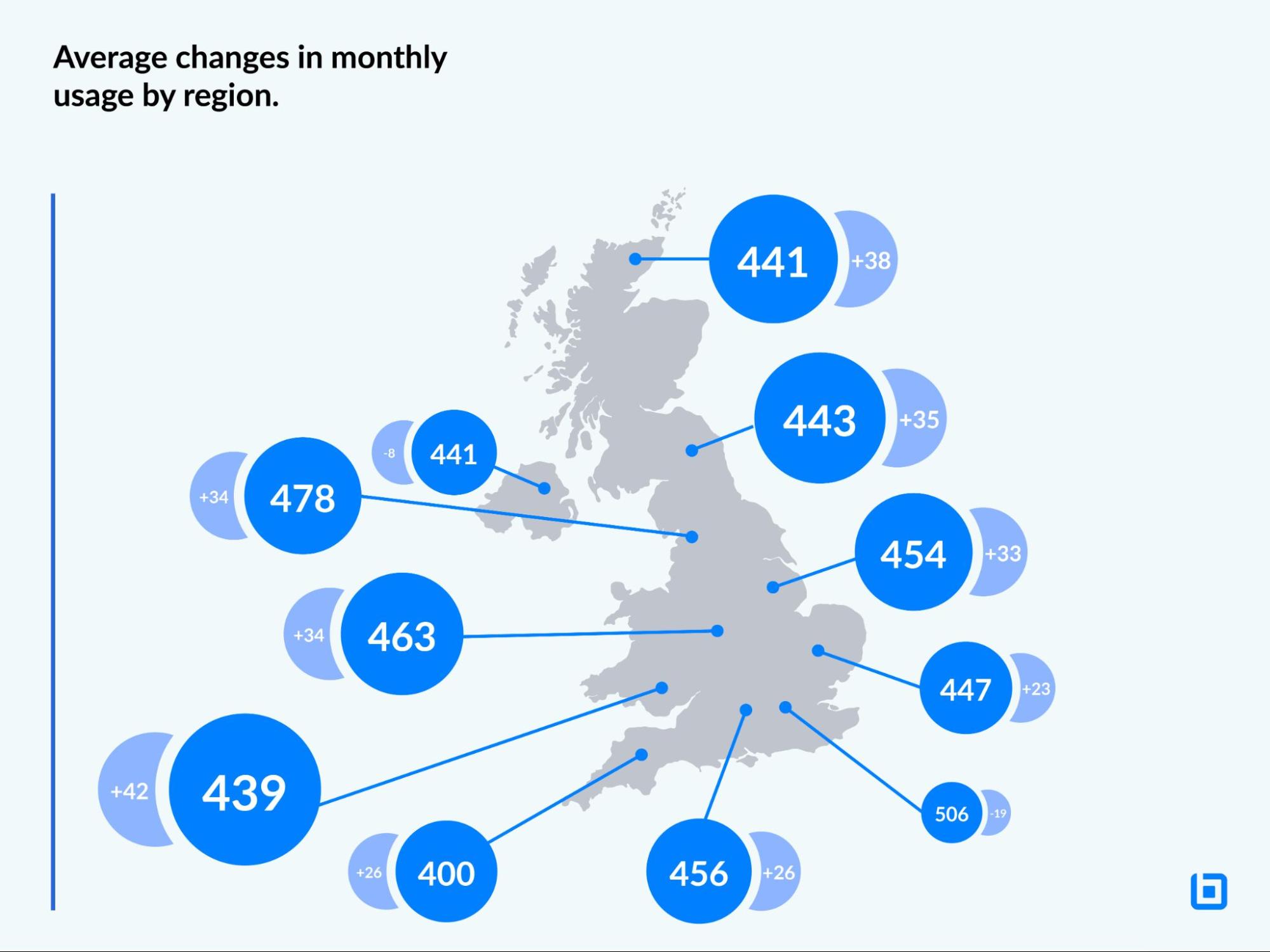
You might recall our UK Internet Usage Statistics report last year, where we used Ofcom data to get a true understanding of how much data UK households use every month. In May 2022, UK households used on average 456 GB/month. The latest Connected Nations report shows this has now increased to 480 GB/month.
Whilst there is likely to be a degree of seasonality in this shift, the increase in Superfast and Ultrafast connections could have contributed to the uplift in usage. Seamless, uninterrupted use of data-intensive online services with faster internet speeds, such as audio and video streaming, could result in increased usage. On the other hand, slow and unreliable connections can frustrate users and deter them from using such services.
Saveen Rajan adds:
“The increase in average data usage from 456 GB/month to 480 GB/month highlights the growing reliance on high-speed broadband for everyday activities. This rise can be attributed to the rising popularity of data-intensive services, the proliferation of smart devices and IoT, and the expansion of superfast and ultrafast connections.”
The following graphic and table shows the average changes in monthly usage by region:
| Region | Avg. Monthly Usage Jan 2022 (GBps) | Avg. Monthly Usage May 2022 (GBps) | +/- |
|---|---|---|---|
| East Midlands | 487 | 454 | 33 |
| East of England | 470 | 447 | 23 |
| Greater London | 487 | 506 | -19 |
| North East | 478 | 443 | 35 |
| North West | 512 | 478 | 34 |
| Northern Ireland | 433 | 441 | -8 |
| Scotland | 478 | 441 | 38 |
| South East | 481 | 456 | 26 |
| South West | 425 | 400 | 26 |
| Wales | 481 | 439 | 42 |
| West Midlands | 497 | 463 | 34 |
class="font-semibold">In Summary
- The latest Ofcom Connected Nations report shows that uptake of Superfast and Ultrafast has increased in households across the UK, but way behind the rate of rollout of full-fibre connectivity.
- Standard connections have reduced in every region of the UK, with 13.6% fewer households choosing Standard broadband.
- Superfast and Ultrafast increased by 7.9% and 5.7% respectively.
- 76% of households now have Superfast connections.
- Just 9.6% of households have Ultrafast connections, despite reports of full-fibre coverage for 50% of households.
- There are several barriers to adoption of Ultrafast broadband, but cost seems to be the most significant barrier. This will only be exacerbated by the price hikes seen in April, which is likely to price many households out of Ultrafast broadband packages.
- Lack of awareness is also a key factor in the slow uptake of faster home broadband speeds. The Government and ISPs need to do more to educate consumers and familiarise them with the terminology.
class="font-semibold">Methodology
- We took Ofcom's Connected Nations data, which has connectivity and usage stats at postcode level.
- We assigned postcodes to streets, towns, cities and regions, to give us totals and averages by location.
- We compared connectivity against Ofcom's announcement of 50% full-fibre connectivity by March 2023.
- We compared connectivity and usage stats against previous Ofcom results.
Notes
A limitation of the data set used is that there isn't a count of individual properties, therefore it was assumed one connection equals one household. There will be instances where properties have more than one connection.
class="font-semibold">Sources
- https://www.ofcom.org.uk/research-and-data/multi-sector-research/infrastructure-research/connected-nations-2022
- https://telecoms.com/520010/ftth-to-pass-half-of-uk-households-in-march/
- https://www.point-topic.com/post/uk-fixed-broadband-bundled-tv-services